
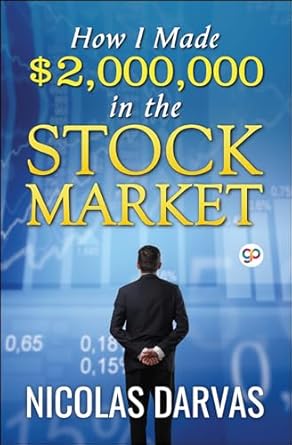
Can you imagine turning a few thousand dollars into over $2 million while traveling the world — without even being a professional trader? That’s exactly what Nicolas Darvas, a self-taught dancer turned investor, did. His story is one of the most inspiring examples of discipline, simplicity, and emotional control in trading history.
🧠 Who Was Nicolas Darvas?
In the 1950s, Nicolas Darvas was a successful ballroom dancer who spent most of his time touring globally. Between performances, he developed an interest in the stock market — not as a gambler, but as a student of price action.
With no formal finance education and limited access to Wall Street, Darvas created a systematic trading method that helped him grow a small investment into $2 million (a fortune in those days).
And he did all this by mailing orders through telegrams, reading stock reports, and following strict rules — not emotions.
💡 What the Book Is About
This book isn’t just about one man’s fortune — it’s about how a logical system can beat emotional trading.
Darvas explains his journey from being an amateur who chased “hot tips” to becoming a disciplined trader who followed charts, patterns, and psychology.
His famous “Box Theory” remains one of the simplest and most effective trend-following systems even today.
📦 The Darvas Box Theory (In Simple Terms)
Darvas observed that strong stocks tend to move in “boxes” or price ranges.
Here’s how it works:
- When a stock moves sideways between two clear levels — it’s in a box.
- When the stock breaks above the top of that box with volume — it’s a buy signal.
- You hold the position as long as the stock forms new higher boxes.
- If it falls below the box’s lower boundary — it’s a sell signal.
This allowed him to ride trends, avoid market noise, and stay objective.
💎 Key Lessons from the Book
1. Ignore Market Tips
Darvas learned early that following “hot stock tips” or broker recommendations was a losing game. Instead, he trusted only his system and data.
2. Price and Volume Tell the Truth
He focused purely on price movements and volume surges — believing they reflect what informed investors are doing behind the scenes. Fundamentals mattered less than market action.
3. Cut Losses Quickly
Every time a stock fell below his box, he exited — no questions asked. This disciplined approach protected him from major drawdowns and emotional decisions.
4. Let Winners Run
Darvas’s biggest profits came from stocks that continued breaking out into new boxes. Instead of taking small profits, he let trends play out fully — a lesson modern traders still struggle with.
5. Keep Learning and Adapting
He refined his system constantly. When something didn’t work, he didn’t quit — he analyzed, adjusted, and improved.
6. Emotional Control Is Everything
Darvas admitted that his worst losses came from excitement and overconfidence. He realized that success in the market comes from controlling emotions, not predicting prices.
7. Trade What You See, Not What You Think
He focused on behavior, not beliefs — following price action instead of opinions. This mindset made him immune to the noise that traps many traders.
⚖️ Why This Book Still Matters
Even though Darvas traded in the 1950s, his principles are timeless. His focus on trend following, risk management, and discipline forms the backbone of modern trading systems — including swing trading and breakout strategies used today.
His story is living proof that you don’t need Wall Street connections or complex algorithms to succeed — just logic, patience, and rules.
🏁 Final Thoughts
How I Made $2,000,000 in the Stock Market is more than a success story — it’s a trading mindset manual.
It shows how a curious mind, disciplined approach, and clear strategy can outperform even professional investors.
If you’re tired of emotional trading and want a structured, repeatable way to find winners — this book is your blueprint.
🔑 Key Takeaway
You don’t need to predict the market — just follow the trend with discipline and protect your capital.