
If you’ve been trading for a while, you’ll know this — the charts may change, the platforms may get faster, but human emotions in trading never change.
That’s why the best trading lessons aren’t from Telegram groups or “stock tips” — they’re from books written by traders who actually lived the game.
Whether you trade intraday, swing, or invest long-term — the following five books will reshape how you think, trade, and survive in the markets.
These aren’t motivational books. They’re battle-tested roadmaps — written by people who lost, learned, and then made fortunes.
Here are five timeless trading books that have shaped thousands of successful traders across generations — from Wall Street legends to modern-day day traders in India.
#1. Reminiscences of a Stock Operator — Edwin Lefèvre

Reminiscences of a Stock Operator — Edwin Lefèvre
The stock market is never obvious. It is designed to fool most of the people, most of the time. This isn’t just a book; it’s the life story of Jesse Livermore, the man who made and lost fortunes multiple times.
Livermore started as a chalk boy in a brokerage house and rose to become one of the most successful trader of all time — by trusting price movements over opinions.
💡 What You’ll Learn:
=>Discipline over excitement — controlling greed and fear is harder than reading charts.
=>Patience pays — the big money is made in the big moves.
=>Avoid tips and predictions — focus on what the market is doing, not what you hope it will do.
It’s amazing how something written a century ago still feels like it was written for today’s markets. Every trader who reads this book sees themselves in Livermore’s journey — the mistakes, the emotional swings, the evolution.
#2. How to Day Trade for a Living — Andrew Aziz

Trading looks easy when you’re winning, and impossible when you’re losing. The difference is your system.
Andrew Aziz doesn’t sugarcoat it — day trading is tough. But he breaks it down into a structured, learnable process.
This book teaches how professionals approach day trading as a business, not a gamble.
💡 What You’ll Learn:
Setting up your trading workstation and tools
Risk-to-reward and position sizing strategies
Importance of having a trading journal and reviewing mistakes
How to build discipline and routine around market hours
Aziz’s biggest strength is how real his writing feels. He’s honest about failures and transparent about what works — especially for retail traders who have day jobs and limited capital.
#3. Trading in the Zone — Mark Douglas

If there’s one book that turns traders into professionals, it’s this one.
Mark Douglas digs deep into the psychology of trading — why we repeat the same mistakes, why fear of loss controls us, and how to build a mindset of confidence and detachment.
💡 What You’ll Learn:
How to think probabilistically — accepting that no trade is guaranteed.
Why most traders lose money even when their strategies are sound.
How to reprogram your mind to trade with consistency, not emotion.
This isn’t a “strategy” book — it’s a mindset manual.
If you’ve ever rage-closed a trade or doubled down out of ego, this book will hit you hard — and heal you slowly.
#4. How I Made $2,000,000 in the Stock Market — Nicolas Darvas

How I Made $2,000,000 in the Stock Market
Nicolas Darvas was not a broker or analyst. He was a professional dancer, who discovered a system that made him a millionaire while touring the world!
His secret? A simple, rule-based approach called the Darvas Box Theory.
💡 What You’ll Learn:
How to identify stocks breaking out of a price range (box).
The power of trend following and volume confirmation.
Why cutting losses quickly is non-negotiable.
How to stay detached from the noise and trade objectively.
Darvas’ story proves that you don’t need insider knowledge or fancy tools — just logic, patience, and conviction in your system.
His method still works in modern markets because human behavior never changes.
#5. How to Make Money in Intraday Trading — Ashwani Gujral
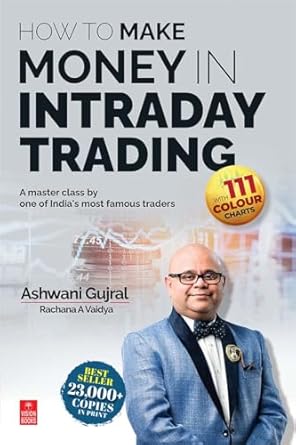
How to Make Money in Intraday Trading
Ashwani Gujral is one of India’s most followed traders — known for his direct, no-nonsense take on the markets.
In this book, he brings decades of Indian market experience to teach what it really takes to succeed as an intraday trader.
💡 What You’ll Learn:
How to trade momentum stocks and index futures like Nifty & Bank Nifty.
The importance of capital protection and strict stop losses.
Common psychological traps: overtrading, revenge trading, and greed.
Why discipline and mindset are more important than finding the perfect setup.
This book hits differently for Indian traders — because the examples, volatility, and emotional cycles are exactly what we face every day in the markets.